Showing posts with label cars. Show all posts

Tuesday, April 12, 2011

Road Diets + Streetfilms and the Streetsblog Network


When I am having conversations with people about "complete streets" or "road diets", I sometimes wish I had Streetfilms videos on me at all times.

Streetfilms is a part of the massive national alternative transportation blog network, Streetsblog. This giant blogging network had humble beginnings in New York City in 2006. It was created by Transportation Alternatives, a well known transportation advocacy group in NYC, along with a couple other groups. Since then, it has since become the predominant online presence within the livable streets community. The Streetsblog network includes hundreds of blogs and writers all over America. Currently, four metropolitan areas are covered by the blog itself: "NYC", "LA", "SF", and "Capitol Hill". There is also a section of the blog titled "Network", which covers stories from other areas.

Anyways, there is a section of the Streetsblog website featuring short videos about the livable streets movement: Streetfilms. These videos are professionally produced. They are short enough to be interesting and long enough to be educational. Recently, Streetfilms began a series of videos called "MBA: Moving Beyond the Automobile." They post a new video every Tuesday. Each short clip features information about Bus Rapid Transit, Car Sharing or some other aspect of alternative transportation.

Today they posted a great video about Road Diets:

Moving Beyond the Automobile: Road Diets from Streetfilms on Vimeo.


Enjoy watching and check out the rest of the Streetfilms website for more of these great videos.

Monday, July 5, 2010

Capping Freeways vs. Taking Them Out: Lessons from the Big Dig


Today, I spent a lot of time ambling around a recently built park in Boston. It is called the Rose Kennedy Greenway, and it is a nice public space. It is diverse, containing fountains, benches, flowers, lawns, long walkways and sculptures. The greenway is surrounded by densely populated areas, providing a green space for many who previously did not have one. The linear aspect of it makes it an ideal place for walking, running, biking and other forms of recreation.

Why is this park so unique?

It is located on top of I-93, a major interstate highway.

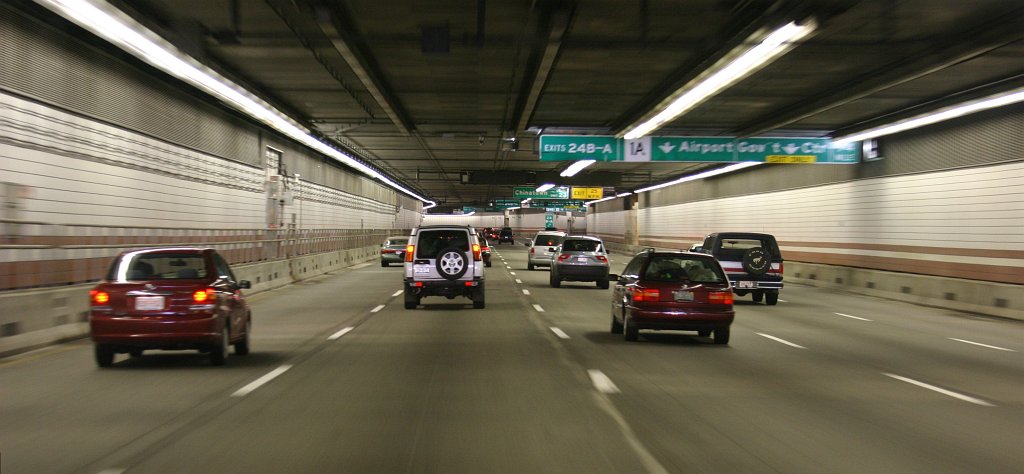
The Big Dig, completed in 2006, was the most expensive public works project in recent American history. At the cost of $15 billion dollars, a major raised freeway was torn down, placed underground (with added lanes), and covered with a greenway/park. The results speak for themselves: when cars once flew by at 70 mph, people now run and play frisbee.

On the other hand, $15 billion dollars is a lot of cash. What if there was a cheaper solution? What if all that money was used to restore and refurbish every decaying Boston subway line instead?

Though this project is unarguably a major benefit for the city of Boston, it is truly just a small Band-Aid upon many gaping freeway scars. One of these scars occurs just steps from my hotel, where I-93 continues uncovered. This section of freeway is surround by decaying buildings and homeless people. The cars flying by are loud and polluting. Even where the highway is covered, there are smaller connector roads where the car speeds are still high. Taxi drivers recklessly fly around corners, causing pedestrians to run in fear. There are no bike lanes in this area, forcing bike riders to dodge pedestrians on the sidewalk.

Beyond this, there are vast parking garages surrounding this new park. There massive buildings do not contribute to street life, and their presence encourages people to continue driving.

What am I getting at?

Freeways are only one small part of the problem; all of the car based infrastructure is the real wound.

What if instead of covering the freeway, the freeway had been removed instead?

Some would argue that absolute chaos and gridlock would instantly occur; I disagree.

If this freeway had been removed, than vehicle drivers would learn that driving in this area would no longer be pleasant or efficient. They would either drive to the edge of it and park, sit in traffic, or bike, walk and take public transit.

Did I mention that there are multiple subways stops that directly border this park/freeway?

What if that money had been used to improve the aging metro system instead?


Here is what would occur:
Time after time, when road capacity is reduced, less people drive. As a result, less road capacity would mean less parking structures would need to be constructed. Instead of a ten story parking structure, a ten story mixed use building could be built in its place.
The people living and working in this building would not be as interested in driving since driving would be challenging in this freeway free area. Their use of a new transit system (built instead of the buried highway with the same $15 billion) would further enforce the idea of transit being a wise investment.
They could also use the new state of the art bike network (built with an extra few million leftover form the original $15 billion) to get where they need to go. Bike sharing systems would provide options for people who would prefer not to buy their own bike (more news on global bike sharing systems here).
The variety of options provided to them at all hours of the day would more than make up for the lack of a car. Zipcars and other car sharing systems would help to fulfill the desire the take a spontaneous weekend trip or a jaunt to Ikea.

How should we spend our precious transportation tax dollars?

I have some ideas...

Beantown: Urban Form and Function


Density: The part of Boston I am staying in (Back Bay) is quite dense, especially compared to the rest of the United States. This makes sense as Boston is one of the oldest American cities. It is also very diverse and educated, being home to a massive number of universities.

The city itself is different from many of the other older American cities (Philadelphia, NYC, Wash. DC) because it is not planned on a grid system. Its streets are chaotic and ancient, creating an interesting urban area with many urban layers. Much of the current city is also built on landfill, causing adjacent neighborhoods to be sometimes completely different.

As with most major American cities, Boston went through a serious decline/ urban renewal process a few decades ago. This led to the construction of some notoriously ugly modernist buildings (Boston City Hall). However, many locations that recently were open lots/surface parking have been transformed into lofts and other new/New Urbanist developments. A major project, called the Big Dig, recently covered a major freeway with a park. Though this project has been beneficial, some residents are unhappy about the quality of the new public space and the price of the project. However, it is really encouraging to see this city recovering from a period of serious urban decline. This success is in no small part due to the previously mentioned large number of universities.

All of this information goes to the back of my head as I witness an urban battle over space occur in Boston: cars vs. everything and everyone else.

This is not a new battle; it is constantly occurring everywhere. It happens to be especially fascinating to witness in Boston due the contrast of an ancient city and a relatively modern freeway network.

As recently mentioned in this Streetsblog video, the city of Boston is quickly becoming more bike friendly. It is astounding that this city was previously bike unfriendly (did I mention how many universities are located here?!?) and the city continues to have plenty of elements of a bike unfriendly city. Looking out my hotel window, there are encouraging symbols of the future to come, with brand new bike lanes, sharrows and bike boxes all visible from my room.

Just yards away form hotel exists a major freeway. This freeway is surrounded by properties in continual decline and areas that feel dangerous at night. The continual negative externalities of a surface freeway system continue to haunt many once beautiful Boston neighborhoods. Cars continue to speed by on wide urban arterials. Drivers continue to ignore pedestrians and bicyclists. Car sharing vehicles (Zipcar, etc.) are rarely if even seen, and a bike sharing network that was supposed to be up and running is nowhere to be found. Suburban style development rubs elbows with historic neighborhoods. Some metro stations are found outdoors under double tiered freeways, creating a dangerous and unfriendly pedestrian environment. Others are found in dark, old dirty tunnels, filled with squeaky trains that frequently break down.

How do we want to develop our cities? What do we want our future cities to look like? How much sense does it make to continue heavy subsidies for a network that depends upon finite fuels and massive amounts of valuable real estate?

It's time for a transportation revolution.

Thursday, April 22, 2010

Cyclivia in Tucson: The Posibilities for the Future

This past weekend, Tucson had its first cyclovia event.


On Sunday, from 10 AM until 2 PM, four sections of different streets were closed off to automobile traffic, freeing the streets for non-motorized activities for miles. This page has more information, and this blog has a good write up of the event.

The purpose of a cyclovia is to allow all uses other than automobiles on the streets. The problem with doing this in Tucson is the quality of the pavement. Most sections of the route were not smooth enough to allow for skateboarding, long-boarding, roller blading and other activities that require smooth pavement. This is unfortunate because some members of the community really enjoy these activities and would love to have an entire street to participate.

Overall though, it is hard for me to be pessimistic about this event. There were a lot of people out participating and interacting with the built environment in a more sustainable way. When people move more slowly through a place, they can interact with it better. They can see how bad of condition the streets are in and contact the city, demanding improvement. They can find neat restaurants and cafes they never previously noticed.

The best thing about cyclovia is taking street space away from cars. Though it was only for 4 hours on one day of the year, it represented an opportunity to take back the streets. For too many years, American transportation policy has dictated that cars are the only way to get around efficiently.

This is simply not true. Plenty of places in America are easily accessible by foot, bike or transit.

For the places that are not yet accessible,efficient land use policy can help to change this unfortunate reality.


It is also telling that much of this cyclovia route will soon be home to the route of Tucson's first modern streetcar. Construction will begin this fall (Oct./Nov. 2010), and according to project managers, the project will be complete in about 15 months. This means that next year on April 18th, the cyclovia route will look very different.

In five years, the route will probably be very different as well. Construction on the streetcar will have been completed for a long time. Development will probably be occurring along the route, and the recession will hopefully be far over.

However, the real question should be what will the first Tucson cyclovia route look like in ten years? Only time, and progressive planning policy, will tell.

Monday, April 5, 2010

What Methods Can We Use to Prevent People from Buying a Car in the First Place? 1. Carsharing

I would like to start this post with a disclaimer: I am not an anti-car person, and I never will be.

Motor vehicles are amazing inventions. They increase mobility for the users and allow owners of cars to go wherever they want whenever they want.

However, there are a few drawbacks to a car oriented society: not everyone can afford one because they are expensive to maintain. Also, since our entire build world has become so motor vehicle centric, not owning a car has become a major disadvantage. Our roads are overcrowded, so how can we prevent people from needing to buy a car?

I say "need" because many times, cars are not bought on a "want" basis. Though many times they are, plenty of people buy cars based on "need".

People buy cars if their transportation needs are not adequately met by transit, walking, biking or car sharing. Most of America fits into this category, so it makes sense that most Americans own cars.

Why do I want people not to buy cars?

Well, this is how it usually goes: once someone buys a car, all they use is a car. They no longer consider using buses, bikes or walking because a car is such a large investment. It doesn't make sense for someone to make a large investment for something they will use occasionally. Also, our modern build world reinforces high intensity vehicle usage. When someone buys a car, they reinforce this entire cyclical system.


Though the solution to this problem is multifaceted, I see car sharing as the most important solution to this problem.

I would like to use my own personal life as an example.

I do not own a car. Though I had one when I attended high school in Albuquerque, my brother now uses that car so I have no car out here in Tucson. I have no problem with not owning a car. I enjoy biking to school most days because it stimulates my mind and gives me exercise. On the days when I do not feel like biking (sick, raining, windy, lazy, etc) a bus route passes very close to my house and takes me directly to campus. This bus route is pretty good, as it comes every half hour on weekdays from 5 AM to 10 PM. Since most of my time is either spent on campus or at home, the bus and bike connections work very well for my commute.

But what about everything outside of my daily commute?

Most American driving miles are no longer the simple commute to and from work or school. People need to get to baseball practice, the mall, Baskin Robbins, the movie theater, concert and a billion other locations and events. In most cities, since everything is so spread, you sometimes truly do NEED a car to get to many of these locations.

For example, I need to buy groceries once a week. I prefer going to Trader Joes, which is too far to bike to and inaccessible by bus. Luckily, I have some awesome roommates who let me borrow their car once a week for this journey.

Alas, most people do not have my awesome roommate situation. It is at this point when most people decide that they must own a car. It is these kind of journeys that need to be tackled in order to reduce car purchases. Car sharing is the answer.

How does car sharing work? The most popular car sharing program in the nation, ZipCar, works like this: cars are distributed in a given area. People in this given area sign up for a membership. When members want to use a car, they get on the Internet (or iPhone), find the closest one, scan the car with key less entry, and go for as long as they want. The longer they go, the most they have to pay so there are incentives for people to bring the cars back ASAP.

Now, if there was a bank of these cars in my neighborhood, I would totally sign up. I would not be the only one, as my neighborhood is filled with lower income car free dwellers. The problem is, Zipcar is still a for-profit company. They will only expand into areas where profit margins are high and risk is low. Central Tucson is probably not high on their expansion list.

This is why Ray LaHood and livability proponents need to start doing more work to get local car sharing programs jump started. I am so happy to see the federal DOT give so much more credit to bikes, pedestrians and transit, but these solutions will only go so far. Car sharing should also be a big part of their push for livability.

Though car sharing still involves cars (which I am not a huge fan of) they are an essential part of any solution in society that has only been building car based for at least 70 years. Honestly, they are the most realistic solution to getting cars off the road. Just look at this infographic, and this article (both from FastCompany), for proof.

Let's stop the cycle of people needing to buy cars; add car sharing to a growing list of great solutions.

Sunday, February 7, 2010

The Extreme Importance of Zoning Policy

The cities we have created today are relatively unsustainable. By unsustainable, I mean a place that can not easily survive for a long period of time. The primary reason behind this is zoning policy.

There are two major issues with current zoning policy:
1) Subsidizing Sprawl: We continue to pour money into developments that make our city weaker instead of stronger.

We can even look at this kind of development from a purely economic standpoint: In the long run, it is far more expensive to construct and maintain new infrastructure than it is develop areas that already have infrastructure. For this reason, local and national government should give major tax breaks to infill development, opposing to greenfield sprawl. In places where infrastructure exists, other services (such as shopping, workplaces, schools, etc.) are likely to exist as well. This not only creates lower longer-term prices for taxpayers, but it also encourages and stimulates walkable development. As many studies have shown (the most recent one from the NRDC), walkable areas retain value much better than non-walkable areas do.

2) Single Use Automobile Dependent Zoning Policy: Most new development in the United States continues to be single use and car dependent. This kind of development is a major reason why the obesity rates in the United States have skyrocketed. Creating areas and communities where people do not have the option of walking, biking or using public transportation is detrimental to the health of this country.

America prides itself on the freedom and independence car ownership provides, but car ownership should not be (and is not) a necessity for everyone. In my opinion, freedom means building areas where people have the freedom to use any transportation option they want.

Federal and local governments MUST revise zoning policies that encourage single use car dependent developments. Continuing to build these spaces will just lead to more pollution and congestion on local roads, and the eventual collapse of local transportation systems. Only so many lanes can be added to a road; eventually, the right of way ends.


Let's Review:

We must fight to end tax subsidies for sprawl.

We must subsidize infill development instead.

Car dependent development weakens our country.

Freedom means transportation options, not automobile dependency.

Revising zoning policy is crucial to the future of this country.


In my next post, I will address a balanced solution for future suburban growth that embraces the tenets of progressive urban policy.