Showing posts with label highways. Show all posts

Sunday, July 11, 2010

The Layers of NYC


Yesterday, I spent the day touring New York City. I saw many interesting bits of urbanism, from the World Trade Center construction site (which, after years of delays, is finally being reconstructed) to the High Line (an old raised urban railroad that has now been turned into a spectacular park/public space).

New York City is a place like no other, especially in the context of America. Its density and population is unrivaled by any other urban area in these United States. It's transit system is not only extensive, but it is also used by a majority of the population. The city has recently received positive attention from the urban planning world as a result of the new planning director in NYC Janette Sadik-Khan. Her new policies on creating bike friendly and pedestrian friendly infrastructure have caught the eye of planners across the globe.


When I visit places like NYC, I try to figure out what exactly makes the city such an interesting and desirable place, both to live in and to visit. Parts of the answer may be obvious (such as Central Park), but some aspects of the city seem like true turn-offs. The streets are filled with speeding, stinky cars. The subway stations are old, dirty and hot. The traffic is terrible, and it is almost impossible to find one peaceful, quiet spot in the entire city.

So why go?

For people who live there, the simple answer might be employment. But in my opinion, time is the thing that truly makes this place fascinating.

Since people have been living on this little island for such a long time, layers and layers of culture, history and urbanism have been created over time. One could walk for 3 blocks and hear 20 different languages, We were sung to by an African-American trio on the subway (they were pretty talented). There were 4 different bands playing at one single relatively small park we visited (Washington Square Park).

This kind of culture can not be created overnight.

The people who argue about the urban/surburban divide never touch on the issue of time. Cities are usually more interesting places than suburbs simply because the cities have existed for a longer amount of time.

Mix of use is also incredibly crucial. When buildings have a mix of uses (basically residential + anything else) they allow people more options about where they live and work. This allows for a variety of transportation options: walking, biking, roller-blading, skateboarding, bus riding, train riding or even automobile driving. People are always clamoring for more options in life; auto dependent development does NOT provide many options.

Overall, time has led to the creation of city filled with layers. It has layers of culture and layers of infrastructure. It is an organically growing place with constant movement and evolution. Some call it the City that Never Sleeps. What allows the city to stay awake all night?

One important aspect of that is the 24/7 subway network. When you have a transportation network running all day and all night, people will use it all day and all night. This is especially true in a city such as NYC, which has high density and a robust diverse economy.


How can we create incredible places such as NYC? Time is one very important ingredient.

A great public transportation network also helps.

Monday, July 5, 2010

Capping Freeways vs. Taking Them Out: Lessons from the Big Dig


Today, I spent a lot of time ambling around a recently built park in Boston. It is called the Rose Kennedy Greenway, and it is a nice public space. It is diverse, containing fountains, benches, flowers, lawns, long walkways and sculptures. The greenway is surrounded by densely populated areas, providing a green space for many who previously did not have one. The linear aspect of it makes it an ideal place for walking, running, biking and other forms of recreation.

Why is this park so unique?

It is located on top of I-93, a major interstate highway.

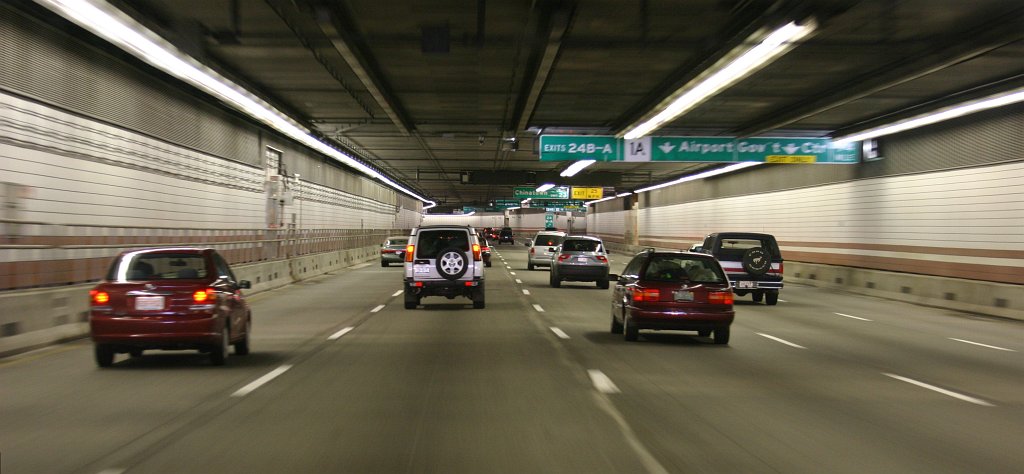
The Big Dig, completed in 2006, was the most expensive public works project in recent American history. At the cost of $15 billion dollars, a major raised freeway was torn down, placed underground (with added lanes), and covered with a greenway/park. The results speak for themselves: when cars once flew by at 70 mph, people now run and play frisbee.

On the other hand, $15 billion dollars is a lot of cash. What if there was a cheaper solution? What if all that money was used to restore and refurbish every decaying Boston subway line instead?

Though this project is unarguably a major benefit for the city of Boston, it is truly just a small Band-Aid upon many gaping freeway scars. One of these scars occurs just steps from my hotel, where I-93 continues uncovered. This section of freeway is surround by decaying buildings and homeless people. The cars flying by are loud and polluting. Even where the highway is covered, there are smaller connector roads where the car speeds are still high. Taxi drivers recklessly fly around corners, causing pedestrians to run in fear. There are no bike lanes in this area, forcing bike riders to dodge pedestrians on the sidewalk.

Beyond this, there are vast parking garages surrounding this new park. There massive buildings do not contribute to street life, and their presence encourages people to continue driving.

What am I getting at?

Freeways are only one small part of the problem; all of the car based infrastructure is the real wound.

What if instead of covering the freeway, the freeway had been removed instead?

Some would argue that absolute chaos and gridlock would instantly occur; I disagree.

If this freeway had been removed, than vehicle drivers would learn that driving in this area would no longer be pleasant or efficient. They would either drive to the edge of it and park, sit in traffic, or bike, walk and take public transit.

Did I mention that there are multiple subways stops that directly border this park/freeway?

What if that money had been used to improve the aging metro system instead?


Here is what would occur:
Time after time, when road capacity is reduced, less people drive. As a result, less road capacity would mean less parking structures would need to be constructed. Instead of a ten story parking structure, a ten story mixed use building could be built in its place.
The people living and working in this building would not be as interested in driving since driving would be challenging in this freeway free area. Their use of a new transit system (built instead of the buried highway with the same $15 billion) would further enforce the idea of transit being a wise investment.
They could also use the new state of the art bike network (built with an extra few million leftover form the original $15 billion) to get where they need to go. Bike sharing systems would provide options for people who would prefer not to buy their own bike (more news on global bike sharing systems here).
The variety of options provided to them at all hours of the day would more than make up for the lack of a car. Zipcars and other car sharing systems would help to fulfill the desire the take a spontaneous weekend trip or a jaunt to Ikea.

How should we spend our precious transportation tax dollars?

I have some ideas...

Beantown: Urban Form and Function


Density: The part of Boston I am staying in (Back Bay) is quite dense, especially compared to the rest of the United States. This makes sense as Boston is one of the oldest American cities. It is also very diverse and educated, being home to a massive number of universities.

The city itself is different from many of the other older American cities (Philadelphia, NYC, Wash. DC) because it is not planned on a grid system. Its streets are chaotic and ancient, creating an interesting urban area with many urban layers. Much of the current city is also built on landfill, causing adjacent neighborhoods to be sometimes completely different.

As with most major American cities, Boston went through a serious decline/ urban renewal process a few decades ago. This led to the construction of some notoriously ugly modernist buildings (Boston City Hall). However, many locations that recently were open lots/surface parking have been transformed into lofts and other new/New Urbanist developments. A major project, called the Big Dig, recently covered a major freeway with a park. Though this project has been beneficial, some residents are unhappy about the quality of the new public space and the price of the project. However, it is really encouraging to see this city recovering from a period of serious urban decline. This success is in no small part due to the previously mentioned large number of universities.

All of this information goes to the back of my head as I witness an urban battle over space occur in Boston: cars vs. everything and everyone else.

This is not a new battle; it is constantly occurring everywhere. It happens to be especially fascinating to witness in Boston due the contrast of an ancient city and a relatively modern freeway network.

As recently mentioned in this Streetsblog video, the city of Boston is quickly becoming more bike friendly. It is astounding that this city was previously bike unfriendly (did I mention how many universities are located here?!?) and the city continues to have plenty of elements of a bike unfriendly city. Looking out my hotel window, there are encouraging symbols of the future to come, with brand new bike lanes, sharrows and bike boxes all visible from my room.

Just yards away form hotel exists a major freeway. This freeway is surrounded by properties in continual decline and areas that feel dangerous at night. The continual negative externalities of a surface freeway system continue to haunt many once beautiful Boston neighborhoods. Cars continue to speed by on wide urban arterials. Drivers continue to ignore pedestrians and bicyclists. Car sharing vehicles (Zipcar, etc.) are rarely if even seen, and a bike sharing network that was supposed to be up and running is nowhere to be found. Suburban style development rubs elbows with historic neighborhoods. Some metro stations are found outdoors under double tiered freeways, creating a dangerous and unfriendly pedestrian environment. Others are found in dark, old dirty tunnels, filled with squeaky trains that frequently break down.

How do we want to develop our cities? What do we want our future cities to look like? How much sense does it make to continue heavy subsidies for a network that depends upon finite fuels and massive amounts of valuable real estate?

It's time for a transportation revolution.

Tuesday, May 4, 2010

Power to the People: Take Power from the States and Give It to the CITIES!


Today, I came across this great article from the site Next American City.

The article basically discusses the problem with federal money being distributed to state governments:
Indeed, the strength of state governments in making transportation decisions is one of the primary culprits for the highway-dependent state of the American landscape, in addition to the federal urban renewal policies and Interstate Highway legislation that are more typically singled out for blame. This fact comes to the serious detriment of metropolitan areas, which lack the fiscal ability and legal right to make full decisions about their transportation futures.

Why does this occur?
That’s because the politics of almost every state are dominated by rural and suburban constituents, or, in other words: car drivers. The urban transit users, pedestrians, and bike riders are typically at the back of the pack when it comes to representation.

The author of the article, Yonah Freemark, calls on Washington to "stem that state power". However, he offers no alternative way for distributing federal money. He seems to be in favor of the Feds having more power in distributing the money.
This issue is also covering in this blog.

I agree with Mr. Freemark: urban areas should have far more power. Money should not even be funneled in to the Feds in the first place; more tax money should be staying within localities. The amount of money each locality has would be based on the amount of economic activity occurring in each given metro area. In the case of money being distributed from a Federal level, it should work the same way: the more valuable the metro area to the economy, the more money it gets.

However, since I am talking about this issue purely from a transportation standpoint, I can see many problems with money being distributed in this manner. Since everything is so road and highway oriented, how could anyone guarantee all the money would not just be used for building new highways?

One solution could be the idea of Federal matching of funds: the more money localities would contribute to non-road projects, the more money would be provided by the Feds for transportation.

Overall though, the main point:
The Feds can not just keep throwing money at states for whatever transportation projects they want. State governments will continue to prioritize road and highway projects because that is the popular thing to do in many jurisdictions (especially the rural ones).

Let the majority be represented. Give urban areas far more political power.

Update (5/8): Here is another blog that discusses this very issue. It suggests giving the power to MPO's (Metropolitan Planning Agencies). All metro areas with a population above 50,000 are required to have MPO's, so it makes sense to distribute federal money through these organizations. In Albuquerque, the MPO is MRCOG, and in Tucson the MPO is PAG.

These groups do a lot of regional transportation planning, so it makes a lot of sense to give these agencies more money, and power.

Update 5/12: Here is great article about the history of road funding. It discusses how the acceleration of the car based transportation system led to money being taken from local control and given over to state and federal control. This [PDF] is the longer article that this previously linked article was summarizing.

We MUST focus on getting our transportation money back to the local authorities. State leaders generally do not understand the idea of "sustainable transit". Metro regions do and they need the money now, more than ever, to invest in sustainable transportation options.