Showing posts with label roads. Show all posts

Sunday, July 11, 2010

Biking in the Cape: Some Lessons and Ideas


Today, my family and I enjoyed a long bike ride through Cape Cod, Massachusetts. This ride was made possible by a national program called Rails to Trails. The program is pretty self-explanatory: previous rail lines are converted into bike and/or multi use trails. It is great program that has led to the completion of many fantastic trails across the nation.

The Cape Cod Rail Trail was very well designed. All of the road crossing points were well constructed, making both the trail and the road crossings easy to traverse for both cycles and motor vehicles. Part of the reason the crossings were so functional was due to the fact that all the at-grade crossings involved only two-lane of one lane roads. All the wider roads had grade separated crossings (usually tunnels, with the occasional overpass). These crossings helped to illustrate a larger point of cycling: people will be far more comfortable cycling if there are grade separated crossings. Yes, this point has been made, and yes they are expensive, but they go a VERY long way towards making life easier for both bike riders/pedestrians and drivers.

So who was using this trail? Since Cape Cod is primarily a tourist destination, I expected to see mostly recreational riders. Predictably, after traversing this trail for its entire length over a period of 7 hours, I saw very few people on the trail who seemed to be locals. This was understandable, considering the wealth of the residents of Cape Cod. But then, I thought about all the service workers in the towns on the Cape; the children who attended the local schools; the people who lived a short, bikable drive away from their place of work: why were these people not present on the trail?

Lack of connectivity is the answer.

Since the trail was built primary for recreational purposes, the planners made very little provisions for commuters. The trail was required to follow the rail right-of-way, which means it doesn't necessarily go close to many of the major towns. In fact, there is only one major town that it passes through. In this town, the whole area around the trail is filled with parks and businesses that cater to bikers. Why can't the other towns in the area have this?

I envision a future where the Cape Cod Rail Trail is the spine of a larger, regional network. There would spurs that would go to every nearby town and every nearby school, along with every nearby major employment center. All of these spurs would have way-finding signs from the main trail. Currently, the majority of the Cape (along with the majority of the USA) is very auto oriented, with little to no commuter bike infrastructure. The development of the peninsula is not necessarily suburban, but it is sprawling and spread out in nature.


My main point is this: having long, recreational trails are beneficial to large portions of the population, but they do little to reduce intra-urban journeys. This type of trip (within an urban area, and usually a short distance, no more than 2-8 miles) is by far the most common trip type in America; it is also the easiest type of car trip to replace with a bicycle.

If we really want to reduce traffic, reduce emissions, reduce auto fatalities and reduce obesity, we MUST focus on the low hanging fruit. In this situation, the low hanging fruit is the potential to replace short car trips with other modes, such as bikes.

If we can build great recreational trails, we can also build quality commuter networks. It's time to stop wasting money on subsidies for car trips that are wasteful and unnecessary.

It's time for a transportation revolution.

Monday, July 5, 2010

Capping Freeways vs. Taking Them Out: Lessons from the Big Dig


Today, I spent a lot of time ambling around a recently built park in Boston. It is called the Rose Kennedy Greenway, and it is a nice public space. It is diverse, containing fountains, benches, flowers, lawns, long walkways and sculptures. The greenway is surrounded by densely populated areas, providing a green space for many who previously did not have one. The linear aspect of it makes it an ideal place for walking, running, biking and other forms of recreation.

Why is this park so unique?

It is located on top of I-93, a major interstate highway.

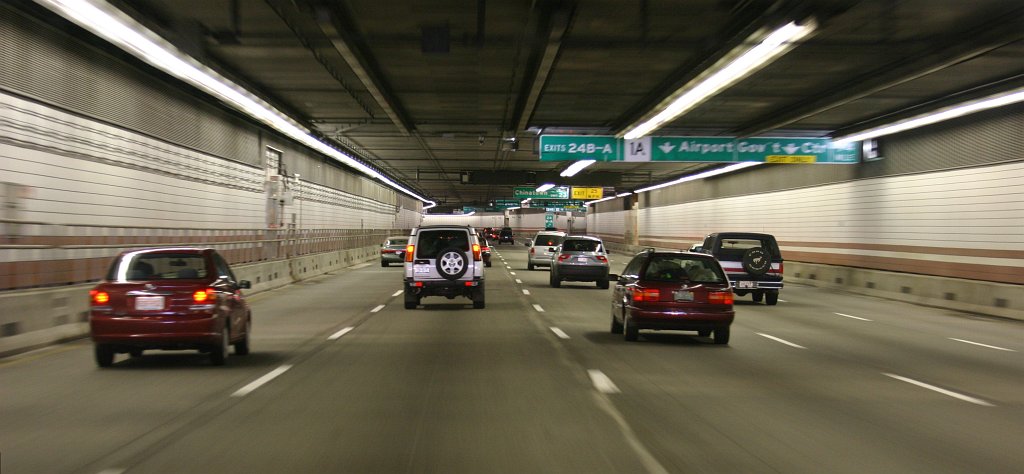
The Big Dig, completed in 2006, was the most expensive public works project in recent American history. At the cost of $15 billion dollars, a major raised freeway was torn down, placed underground (with added lanes), and covered with a greenway/park. The results speak for themselves: when cars once flew by at 70 mph, people now run and play frisbee.

On the other hand, $15 billion dollars is a lot of cash. What if there was a cheaper solution? What if all that money was used to restore and refurbish every decaying Boston subway line instead?

Though this project is unarguably a major benefit for the city of Boston, it is truly just a small Band-Aid upon many gaping freeway scars. One of these scars occurs just steps from my hotel, where I-93 continues uncovered. This section of freeway is surround by decaying buildings and homeless people. The cars flying by are loud and polluting. Even where the highway is covered, there are smaller connector roads where the car speeds are still high. Taxi drivers recklessly fly around corners, causing pedestrians to run in fear. There are no bike lanes in this area, forcing bike riders to dodge pedestrians on the sidewalk.

Beyond this, there are vast parking garages surrounding this new park. There massive buildings do not contribute to street life, and their presence encourages people to continue driving.

What am I getting at?

Freeways are only one small part of the problem; all of the car based infrastructure is the real wound.

What if instead of covering the freeway, the freeway had been removed instead?

Some would argue that absolute chaos and gridlock would instantly occur; I disagree.

If this freeway had been removed, than vehicle drivers would learn that driving in this area would no longer be pleasant or efficient. They would either drive to the edge of it and park, sit in traffic, or bike, walk and take public transit.

Did I mention that there are multiple subways stops that directly border this park/freeway?

What if that money had been used to improve the aging metro system instead?


Here is what would occur:
Time after time, when road capacity is reduced, less people drive. As a result, less road capacity would mean less parking structures would need to be constructed. Instead of a ten story parking structure, a ten story mixed use building could be built in its place.
The people living and working in this building would not be as interested in driving since driving would be challenging in this freeway free area. Their use of a new transit system (built instead of the buried highway with the same $15 billion) would further enforce the idea of transit being a wise investment.
They could also use the new state of the art bike network (built with an extra few million leftover form the original $15 billion) to get where they need to go. Bike sharing systems would provide options for people who would prefer not to buy their own bike (more news on global bike sharing systems here).
The variety of options provided to them at all hours of the day would more than make up for the lack of a car. Zipcars and other car sharing systems would help to fulfill the desire the take a spontaneous weekend trip or a jaunt to Ikea.

How should we spend our precious transportation tax dollars?

I have some ideas...

Sunday, February 7, 2010

The Extreme Importance of Zoning Policy

The cities we have created today are relatively unsustainable. By unsustainable, I mean a place that can not easily survive for a long period of time. The primary reason behind this is zoning policy.

There are two major issues with current zoning policy:
1) Subsidizing Sprawl: We continue to pour money into developments that make our city weaker instead of stronger.

We can even look at this kind of development from a purely economic standpoint: In the long run, it is far more expensive to construct and maintain new infrastructure than it is develop areas that already have infrastructure. For this reason, local and national government should give major tax breaks to infill development, opposing to greenfield sprawl. In places where infrastructure exists, other services (such as shopping, workplaces, schools, etc.) are likely to exist as well. This not only creates lower longer-term prices for taxpayers, but it also encourages and stimulates walkable development. As many studies have shown (the most recent one from the NRDC), walkable areas retain value much better than non-walkable areas do.

2) Single Use Automobile Dependent Zoning Policy: Most new development in the United States continues to be single use and car dependent. This kind of development is a major reason why the obesity rates in the United States have skyrocketed. Creating areas and communities where people do not have the option of walking, biking or using public transportation is detrimental to the health of this country.

America prides itself on the freedom and independence car ownership provides, but car ownership should not be (and is not) a necessity for everyone. In my opinion, freedom means building areas where people have the freedom to use any transportation option they want.

Federal and local governments MUST revise zoning policies that encourage single use car dependent developments. Continuing to build these spaces will just lead to more pollution and congestion on local roads, and the eventual collapse of local transportation systems. Only so many lanes can be added to a road; eventually, the right of way ends.


Let's Review:

We must fight to end tax subsidies for sprawl.

We must subsidize infill development instead.

Car dependent development weakens our country.

Freedom means transportation options, not automobile dependency.

Revising zoning policy is crucial to the future of this country.


In my next post, I will address a balanced solution for future suburban growth that embraces the tenets of progressive urban policy.