Today, I spent a lot of time ambling around a recently built park in Boston. It is called the Rose Kennedy Greenway, and it is a nice public space. It is diverse, containing fountains, benches, flowers, lawns, long walkways and sculptures. The greenway is surrounded by densely populated areas, providing a green space for many who previously did not have one. The linear aspect of it makes it an ideal place for walking, running, biking and other forms of recreation.
Why is this park so unique?
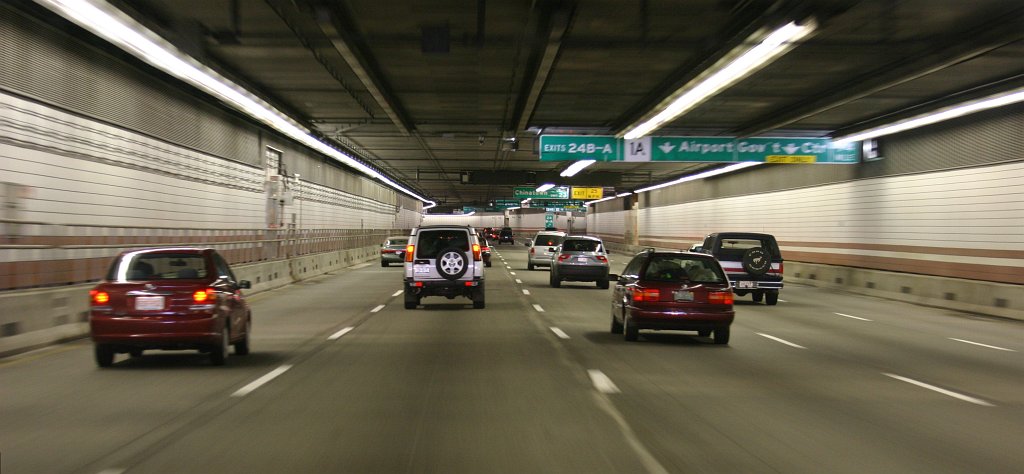
It is located on top of I-93, a major interstate highway.
The Big Dig, completed in 2006, was the most expensive public works project in recent American history. At the cost of $15 billion dollars, a major raised freeway was torn down, placed underground (with added lanes), and covered with a greenway/park. The results speak for themselves: when cars once flew by at 70 mph, people now run and play frisbee.
On the other hand, $15 billion dollars is a lot of cash. What if there was a cheaper solution? What if all that money was used to restore and refurbish every decaying Boston subway line instead?
Though this project is unarguably a major benefit for the city of Boston, it is truly just a small Band-Aid upon many gaping freeway scars. One of these scars occurs just steps from my hotel, where I-93 continues uncovered. This section of freeway is surround by decaying buildings and homeless people. The cars flying by are loud and polluting. Even where the highway is covered, there are smaller connector roads where the car speeds are still high. Taxi drivers recklessly fly around corners, causing pedestrians to run in fear. There are no bike lanes in this area, forcing bike riders to dodge pedestrians on the sidewalk.
Beyond this, there are vast parking garages surrounding this new park. There massive buildings do not contribute to street life, and their presence encourages people to continue driving.
What am I getting at?
Freeways are only one small part of the problem; all of the car based infrastructure is the real wound.
What if instead of covering the freeway, the freeway had been removed instead?
Some would argue that absolute chaos and gridlock would instantly occur; I disagree.
If this freeway had been removed, than vehicle drivers would learn that driving in this area would no longer be pleasant or efficient. They would either drive to the edge of it and park, sit in traffic, or bike, walk and take public transit.
Did I mention that there are multiple subways stops that directly border this park/freeway?
What if that money had been used to improve the aging metro system instead?
Here is what would occur:
Time after time, when road capacity is reduced, less people drive. As a result, less road capacity would mean less parking structures would need to be constructed. Instead of a ten story parking structure, a ten story mixed use building could be built in its place.
The people living and working in this building would not be as interested in driving since driving would be challenging in this freeway free area. Their use of a new transit system (built instead of the buried highway with the same $15 billion) would further enforce the idea of transit being a wise investment.
They could also use the new state of the art bike network (built with an extra few million leftover form the original $15 billion) to get where they need to go. Bike sharing systems would provide options for people who would prefer not to buy their own bike (more news on global bike sharing systems here).
The variety of options provided to them at all hours of the day would more than make up for the lack of a car. Zipcars and other car sharing systems would help to fulfill the desire the take a spontaneous weekend trip or a jaunt to Ikea.
How should we spend our precious transportation tax dollars?
I have some ideas...


