Showing posts with label Spain. Show all posts

Sunday, May 22, 2011

Free Spaces Make for Protest Places


Gathering space for people is important for human society. Take the example of Puerta del Sol in Madrid, Spain.

I spent a fair amount of time in this incredible space just a few months ago. It is truly the Sol ~ soul of the entire country. Every road radiates outward from this point to places all over Europe. It is the center of everything in Spain. Read more about it here.


In the late 2000's, this site, which had been a busy vehicle filled transportation hub, was converted into a mostly car fee space. The transportation has all been moved underground. It is now THE gathering spot of Madrid, as well as the rest of the country.

"Gathering" also sometimes includes protest. This is fantastic. Having a space where people can gather peacefully and safely in large numbers is crucial to a functioning democracy. We all saw how important this was in Egypt with Tahir Square. We also saw how it all plays out when democracy doesn't exist: China, Tiananmen Square, 1989.

Humans have always gathered. It used to be over a campfire but it has changed quite a bit over time.

Watch the live feed below. As of this posting, it shows the occupation of Puerta del Sol in Madrid. How it all plays out will only be known over time. Twitter has played a role but overall, it's space, place and people.


Free live streaming by Ustream

Wednesday, September 1, 2010

ART or GRAFFITI?


I have just completed my short five day stay in Madrid, España and am now in Alcala de Henares to begin my actual studies.

Though I usually write about transportation, I am interested in anything remotely related to urban form and development and this topic is definitely related.

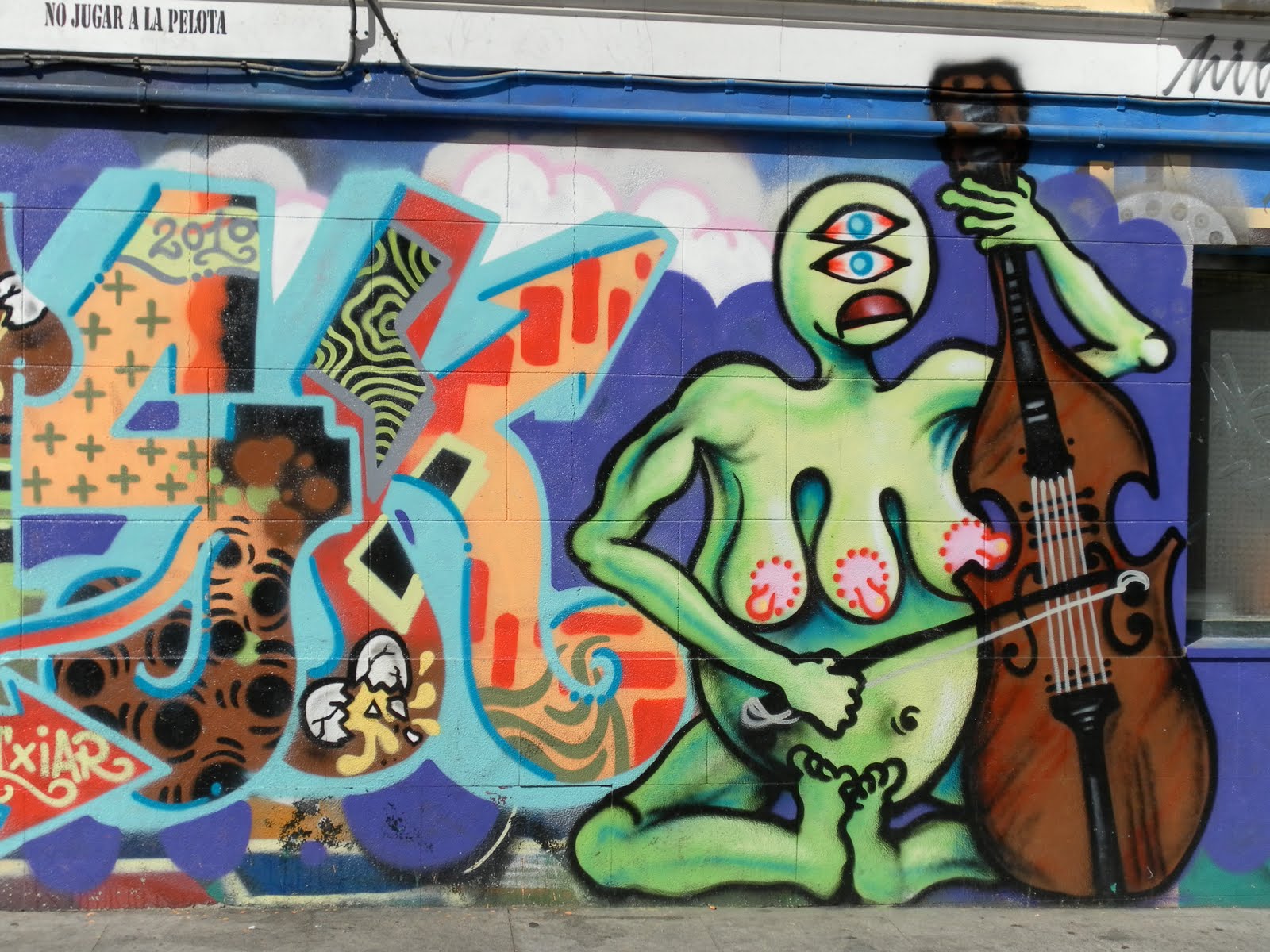
During my adventures through Madrid (by foot and by Metro), I noticed a large amount of paint on the walls of the buildings around me. Some of it was quite ugly and would be considered vandalism by most:


Other examples were more colorful, but would be considered "tags" by many:

However, a "tag" is a pretty negative term to describe the colorful work posted above.

There were many pieces that had tags on top of art on top of tags and onward. Everything became a multilayered piece of work:


And then there was this piece. It is obviously a tag but it made me laugh (value of positive emotional response) due to the resulting geographical juxtaposition of a boutique clothing store + the symbol of anarchy:


Then there were the residents/store owners: some mornings, they would be cleaning the scribbled text off the walls in front of their storefronts. Other retail establishments seemed to embrace the work done on their facade, or maybe they encouraged it in the first place. The store I saw with the most creative solution had a portion of their sign that said "Please do all graffiti here" with an arrow to a portion of the wall.

In the end, this entire situation leads to a question: How do authorities and governments pursue the issue of "street art"? Do they promote some of it and condemn other parts of it? Who makes that judgment call about what should stay and what should not? Does allowing paintings on buildings lead to "taggers" thinking they can mark the walls of the city as well? How much money is the Madrid police spending every year to "clean up" the ugliest of the tags?

In these specific neighborhoods (specifically Malasaña and Chueca), there seemed to be a good balance of the authorities respecting what looked like art and cleaning up the uglier tags.

In my personal opinion, the street art really enhanced the neighborhood. The vivid colors really brightened the narrow streets. It provided me with insight and perspective about the residents of the area. In addition, it helped me to understand the culture in existence without going inside a single residence.

However, I do not live in these neighborhoods; I am simply a visitor. I have a feeling a lot of the residents hate the graffiti, especially the older residents. I also thought about my parents house in Albuquerque; my parents would probably be appalled if any of these colorful forms of expression started popping up in upper-middle class Glenwood Hills.


This whole discussion goes back to the events that occurred just a few weeks ago in Albuquerque.

A few months ago, this beautiful piece of work popped up on the side of a Downtown building.

A couple more similar works popped up around town, but no one talked much about it. The small amount of local discussion I heard about it (through the comments on this post) was mostly positive (Why can't he paint my house?).

Then, the artist, nicknamed the "Rainbow Bandit" for his colorful pieces of self expression on private property, was arrested by APD. This occurred days after a great anonymous interview about him ran in a local "alternative newspaper" called the Alibi.

While I understand the motivation behind his arrest, I have no idea why APD was focusing on him. There are so many other taggers in the ABQ metro area that do some really ugly, crappy work. His colorful drip paint rainbows all over town were beautiful; one of them appeared on a post-crash half-build ugly skyscraper, making this eyesore that much prettier.

So, art or graffiti?

Saturday, August 28, 2010

Goodbye ABQ Ride, Hola España


I have not posted for a long time. This has been due to the fact that I have been extremely busy working at the ABQ Ride offices and preparing to study abroad in Alcala de Henares, España.

This summer, I had a paid internship at ABQ Ride. During my time there, I managed to accomplish my major goal: to resign the ABQ Ride System Map. To give you an idea of the major changes I made to the system map, here is the old one:


As you can see, it is hard to read, cluttered and complicated. Here is my new one:


If you want a direct link to the map on the ABQ Ride website, here is the location.

My priorities for the revised map were an easy to read key and cleaner, less cluttered lines. Another priority I had was showing a better distinction between the lower frequency routes and the higher frequency routes.

Interestingly enough, almost as soon as I was done with the new map, Jarrett Walker of Human Transit wrote a great post about the importance of frequency-based transit maps. Local blogger John P. of Carfree in 'Burque wrote a post in response to the Human Transit post; it included an ABQ Ride Frequency Map. Johns map happened to include many of the elements I added to the new map. This entire situation highlights the potential power of the interconnected Internet to influence ideas and policy.

Though I admit my new map is not perfect, it was the best I could do with the time and resources provided to me.

In addition, this summer I also created 4 other ABQ Ride maps for each of the major system transfer/transit centers: Alvarado, Uptown, Northwest and Central & Unser. Other than the Alvarado map, none of these maps previously existed in any form. I hope these documents can help people more easily navigate the ABQ Ride system.

This summer, I learned many things about life in the office, transit planning, politics, bureaucracy, transit funding, the City of Albuquerque, ABQ Ride and many other things. There is one very important point I would like to write about at this juncture; it is a major difference between the transit system in Tucson (SunTran, which serves an average of 13,534 daily riders) and ABQ Ride (which serves an average of 7,948 daily riders).*

Since both metro areas have a very similar population (and similar demographic indicators as well), one would expect similar ridership. What gives?

Local geography helps to explain the differences: in Albuquerque, the city is divided up by 2 major interstates (1-25 and I-40) + Paseo del Norte + the Rio Grande river basin; in Tucson, the street grid is relatively well connected, with the only major freeway (I-10) skirting the edge of town.

There is also another reason for the difference:

Regional vs. local.

Tucson has a single REGIONAL transportation system. This means that there is one service provider for all the local transportation needs. This makes sense, as Tucson is a relatively small isolated metropolis.

Albuquerque, on the other hand has both a REGIONAL and LOCAL transit provider: ABQ Ride is local, while Rio Metro (the group running the Rail Runner) is regional. This means that funding is DIVIDED between these separate agencies.

How can Albuquerque expect to create a seamless, efficient network when the cash is split up between two different agencies? Though this issue may not be the deciding factor behind the ridership differences in these two cities, I believe it is an important issue that should be discussed by local leaders. After all, I'm not sure Tucson would have received federal dollars for their modern streetcar project without the unified force of a REGIONAL transportation system.

This was my major observation about ABQ Ride vs. Tucson/Suntran vs. regionalism/localism vs. transit networks in general.


Anyways, that all has come to an end and I am now in Spain. I will be here for the remainder of the year, studying Spanish and other assorted things. I will try to blog as often as possible, but I will be studying full time so we shall see.

So, as always, IT'S TIME FOR A TRANSPORTATION REVOLUTION!

---

*All the data used was acquired from the Brookings Institute website from the interactive State of Metropolitan America Indicator Map. If you have not played around with this incredible interactive data set DO SO NOW! It is chock full of interesting, interactive demographic data from across the United States. Have fun!