Showing posts with label Living Streets Alliance. Show all posts

Friday, April 8, 2011

Tucson Transit Task Force and Imagine Greater Tucson: Methods of Shaping Our Future


April 6: First Tucson Transit Task Force Meeting - I met with small group of people from the Living Streets Alliance and from other local groups to brainstorm a strategy for addressing issues of transit funding, expansion and awareness. I learned much about the history of transit in Tucson, from the relationships between the various governing agencies down to the relationships between bus drivers and riders.

The primary reason for our meeting was the discussion of proposed transit fare increases that will be enacted within the coming months. Basically, SunTran has two options: 1) increase fares or 2) cut routes. Increased fares seems like best option but this can sometimes lead to less people using the service, creating even less efficiency overall. However, the propposed fare increases are relatively small and they are probably a better alternative to cutting service.*

Another big discussion topic was the relationship between SunTran and the university. The proposed fare increases would have the most dramatic effect on the discounted annual U-Pass for University of Arizona students. After the meeting was over, it was clear that the future of quality transit in Tucson depended on a close relationship between the university and SunTran. I will continue to drive home this important point within this group.

Last year, I prepared a presentation/proposal for free transit in Tucson for university students. This is a common policy in college towns across the nation, including my home town of Albuquerque. I tried to push my message for a few months but it always fell onto deaf ears. Now, with this new task force, I have a better opportunity to create constructive dialogue with the university.


April 7: Imagine Greater Tucson; The Big Reveal - I attended the "Big Reveal" presented by Imagine Greater Tucson.

What is Imagine Greater Tucson? From the website:
Imagine Greater Tucson is a rapidly growing, community-based effort dedicated to protecting and enhancing our quality of life in the greater Tucson region. Our goal is involve the people of greater Tucson in creating a shared vision for our region’s future, and catalyze the development of strategies to realize this vision.


What does this mean? I had a hard time deciphering it. The event and presentation was interesting but not very groundbreaking. The concepts presented were commonly understood regional goals, such as job growth and quality education. All the attendees appeared to be passionate individuals with a lot of great ideas on how to improve the direction of growth in the Tucson/Pima County region. However, they presented no possible methods that could be used to accomplish the goals they presented. Apparently, these issues will be resolved in future community meetings. Only time will tell.

April 8: Featured on Tucson Velo - As previously discussed, the geovisualization created by my project group and I, "UA Campus Bicycle Geovisualization", appeared on local bike blog Tucson Velo. It was a well written post and I thank Mike for posting our unique Google mashup.

Thanks for reading and feel free to write comments. The more feedback I receive, the better.


*If you are personally interested in the bus fare increases, here is a list of the current fares and the proposed fares. The decision on these increases will be made at a City Council meeting next week. More information on this meeting can be found here.

Tuesday, April 5, 2011

Tuesday Night Community Bike Ride


On the evening of April 5, I participated in the Tuesday Night Community Bike Ride for the first time.

This ride, in one form or another, has been occuring for years. In the past, it has appeared in the local news, receiving both positive and negative press.

I had known about the existence of it for awhile but I had never attended until this week.

First off, it was a blast! Riding in the street with so many riders (I would estimate about 150) was exhilarating. There was also the "saftey in numbers" factor, which made the ride even more enjoyable. I was surprised by the diversity of the group, both of people and bikes. There was a large crew of BMX bikers, a few fixie kids, a bunch of mountain bikes, some calm beach cruisers and plenty of other types. Spanish and English, old and young, loud and quiet all interspersed throughout the beautiful Tucson evening.

Though parts of the route were narrow considering our large numbers, the whole thing was scenic and enjoyable. I have mapped it out based on what I remember below:

View Tuesday Night Bike Ride, 4/5/11 in a larger map

This ride was a fun hybrid between a standard critical mass and an LSA style Family Fun Ride. The pace was mild but we definitely were not following all the traffic laws. We took up lanes, blocked traffic and the BMX riders were all over the place. However, all these aspects of the ride were really fun and interesting, making the ride exhilarating, exciting and fun.

I am glad I went and I am excited to attend another one soon.

Rethinking the Automobile: Communal Carsharing


American transportation, and especially "alternative" and "sustainable" transportation, is sometimes framed in a black and white, "car vs. everyone else" context. This type of framing is especially prevalent among certain portions of the population that only uses single occupancy vehicles to travel around. Since single occupancy vehicles use the majority of public road space, some (and let me emphasize the word "some") car users feel obligated to the road. As a result of this mindset, blowback can occur when space for cars disappears. This phenomenon has been most visible in recent weeks in the conflict over new bike infrastructure being constructed in New York City.


These arguments always confuse me. After all, more space dedicated to biking/walking/using transit usually leads to higher usage of these modes. Higher usage of these "alternative" modes leads to lower car traffic within the road network. This is a direct benefit for users of single occupancy automobiles.

A great way to reframe this argument could be through car sharing. Car sharing changes everything. "Car v. other" becomes "always using a car v. sometimes using a car."

Car sharing is not a new concept. It has been around for a long time in some regions, through it has experienced dramatic growth in recent years. Zipcar is the US leader in developing car sharing as a viable alternative for people who want to use a car occasionally.

However, car sharing is about to change and grow dramatically. This article, from the website TheCityFix, describes a new form of car sharing service appearing in Paris, France. The name of it is "Buzzcar" and it has potential to change the entire auto market. The reason for the appearance of this new type of car sharing are many, but technology and public policy both play large roles. This new type of car sharing is known as peer-to-peer or communal car sharing. It functions in the same way that peer-to-peer file downloading, or torrenting, functions. Basically, there is no central governing body; no one single entity controls the system. It is by the people and of the people. With communal car sharing, you control how much you want to charge for people to use the vehicle, how long they can use it, what condition it should be in, who the person is and much more. This has recently been facilitated through high ownership rates of smart phones and ubiquitous WiFi internet.

As of right now, communal car sharing is mostly restricted to small companies and areas where government regulations support the system. Auto insurance laws have historically restricted the growth of communal car sharing. Now, at least in Oregon and California, this is beginning to change. Since cars sit unused 95% of the time, this market has massive growth potential. Increased fuel prices will only feed this trend.


My recent endeavors
This evening, I attended my third Living Streets Alliance board meeting. We are finally making progress in creating a framework for this group. Trying to figure out how to best manage and divide the tasks we want accomplished will be difficult. Progress was made tonight with the creation of many task force groups, including a transit task force. I will be serving on the transit task force. I aim to address and research the proposed SunTran fare increases, as well as research the relationship between SunTran and the University of Arizona.

I am excited to begin formulating a tangible direction for the transit arm of the Living Streets Alliance. Now it's time for me to stop writing and begin researching.

Wednesday, March 16, 2011

On Public Process: The Interaction Between Local Government and Citizenry


Last week, I attended a city council zoning commission hearing. I attended this meeting with other members of the Living Streets Alliance. This was the culmination of weeks of efforts on the part of Tucson Velo, the Living Streets Alliance and a variety of other local activists.

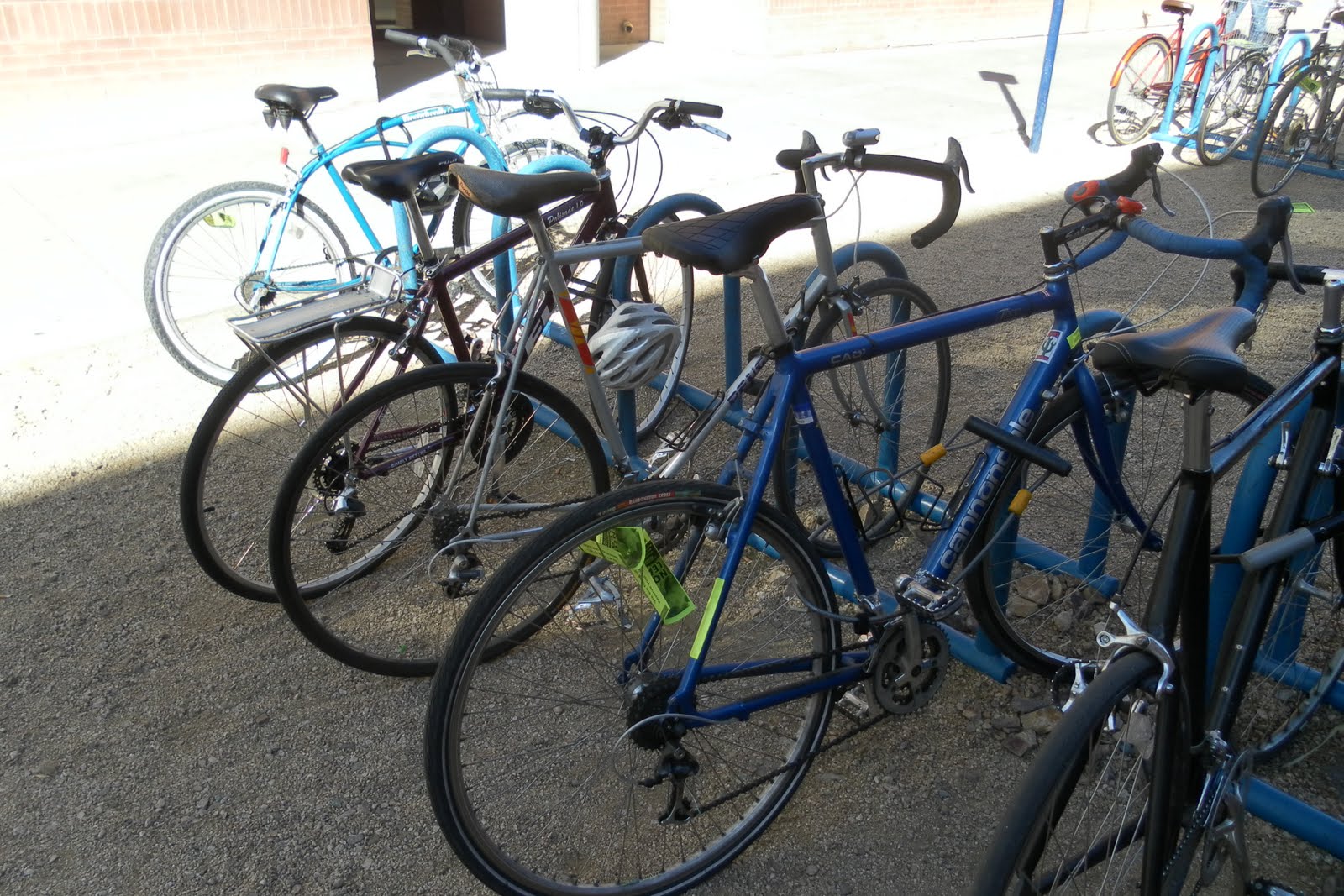
The reason we were at this meeting was bicycle parking policy. The city was trying to pass a revision to the city zoning code that would push bike parking to the periphery of certain developments. The specific section of code states that in certain situations, business owners could push bike parking as far as 75 feet away from the front door. The current maximum is 50 feet; 50 feet is the national standard. Locating a bike rack 75 feet from the door of a business could could result in bike racks being placed in an unsafe side of building location. The lack of visibility would probably result in much lower usage of these facilities as well, making them a waste of money.

Picture from Tucson Velo; taken at the City Council meeting

First, the good: the city council voted to extend the vote for another two weeks so the needs of the bicycle community could be discussed and met. As Tucson Velo later reported, this resulted in a compromise between the city and bike representatives.

Now, the irony: this zoning code was primarily about reducing parking minimums! I was unaware of this fact before walking into this meeting. After hearing this zoning revision discussed, I could only imagine how the city council felt: here was a group of stakeholders who probably wanted these parking minimums to begin with, protesting the passing of a really progressive zoning policy. I hope, and think, they understood where we were coming from.

Why pass an imperfect policy if we could make it better? This, after all, is the whole point of the democratic process. However, the city council was wondering why this problem wasn't hashed out during the multi-month long process of the development of this zoning amendment. This process included many bike related stakeholders as well.

One theory: Jason Wong, a developer who was pushing really hard for the city council to pass the zoning revision that very night. Some believe that he stuck in the regressive bike parking exemption at the last minute.

Whatever the reason, the city council meeting was fascinating. The whole process, from the introductory Pledge of Allegiance to colorful local city residents speaking up about various issues, was eye opening. This was my first Tucson city council meeting and it probably will not be my last.

It was encouraging to see democracy work effectively to resolve conflicts between stakeholders. I think we sometimes forget that the ineffective federal Congress is not the only governing body in the country. Local level government is filled with passionate people who intimately understand the local issues. I am happy to report that the Tucson city council, at least in this example, is of the people, by the people and for the people.

Thursday, January 20, 2011

Recent Developments: Back in Tucson and the Living Streets Alliance


NOTE: This was a post I had started a few months back before spring semester commenced. Since then, things have become infinitely more busy. However, now I have a better idea of the direction I want to move in. This post is a combination of the old material I had previously written and newer updates on my life.

---

It has been a long while since I last posted. This is due to the fact that I have been traveling around various countries in Europe. I was traveling for a few weeks and I saw some incredible European cities.


I had previously read extensively about many of the countries I visited. However, physically visiting these places was an entirely different and wonderful phenomenon. I was able to see, first hand, how a city could be organized around bicycle transportation (Amsterdam, among many others). I saw how high speed rail has become the new normal in Europe and changed the face of long and medium distance travel for the better (Germany, among others). I was able to easily walk or take public transit to every destination I desired everywhere I went.

It was truly wonderful.


Returning to Tucson, AZ for the spring semester I am now involved with sustainable transportation on the local level. Currently, I am working with the Living Streets Alliance.

As of late, I have decided my new career focus is education and advocacy.

---

Newer material; written 2/28

In the vein of education being my newest interest, I recently became a bike ambassador for Pima County. This means that I will be participating extensively in bike events (such as the upcoming Tucson Cyclovia) as well as assisting with other bike education and safety programs.


Another interesting development recently occurred as well. A prominent local bike blog, Tucson Velo, held a letter writing contest. This contest stated that everyone should write letters to the mayor encouraging him to vote against the proposed city zoning code revision that would decrease the accessibility and quality of bike parking in the city.

I ended up writing a letter, which was published on Tucson Velo. When this occurred, a local news woman, Larrisa Wohl, decided she wanted to interview me for a weekly news segment called "2 Wheelin' in Tucson".

Today I was interviewed for this story. I will be posting the video segment as soon as it is released.

On a more local level, I am currently living at 1st Ave. and Linden St. This is in close proximity to the 4th Ave./Fontana bike boulevard currently under construction. The completion of this facility will profoundly affect my neighborhood, as it connects many portions of the denser urban portions of Tucson with each other. Overall, this is a very positive development and I look forward to its completion towards the end of the spring semester.

As previously mentioned, I am very involved with the Living Streets Alliance. I am now an official board member as well. I have met many incredible people through this group and I continue to make many great connections.


Now, the blog itself.

I definitely want to continue blogging. I am currently planning on developing some different blogs with a wider variety of topics. I have changed the theme of this blog too many times to justify continuing with it in the long run. However, until I start those other blogs, I will continue to use this blog as my primary platform for updates on my life and work.